Showing posts with label edpolicy. Show all posts

Do Not Disturb: Thoughts on the ISTEP mess in Indiana #edchat #INeLearn


Well, this has been a fun week. This was suppose to be the week our students in Indiana took the ISTEP exam. The exam that is suppose to measure how much our students have learned over the course of the year and how well our teachers have taught them. As a former classroom teacher, I've gone through the speech with my students time and time again.

"Go to bed early. Eat a good breakfast. Take your time. Read each problem carefully. Do your best!" 

I've sat through all the speeches from administrators and test coordinators. 

"Don't leave the test unsupervised. Make sure students work on every problem and take their time. Make sure all test material are returned and locked away at the end of day."

The multiple choice portion of the test was online this year. The state spent at least three years preparing for this day. Then a funny thing happened...it didn't work!

For the past 2 days students have watched globes spin on their screens while the test remains in limbo. I'm on an email list with other technology directors and watching the emails come in has been both frustrating and slightly entertaining. 

Here are some stories that have come out the last couple of days on this disastrous event. 

Frustrated Ritz pulls plus on ISTEP-Plus testing for Tuesday
ISTEP glitches lead to state-wide halt in testing
Day 2 of ISTEP Glitches
DOE ask schools to decrease ISTEP testing load by 50%

I could go on and share 100+ articles on the issue but I won't. However, I do want to share a couple of my thoughts on this issue.

Is this year's ISTEP test a valid test?
I have a hard time believing any ISTEP test, past or present, is valid. It is impossible to get a clear picture of what students actually know and/or what teachers have taught on a test that only takes up a "few days" out of 180 days of school. I put few days in quotes because all teachers know that high stakes test take up more than just the days we administer them. 

Actually, I would actually say that high stakes test steal days away from our students. Days that our students could be spending exploring their interest, creating something, working on a service project with their classmates, or finding their voice in a space by themselves. 

Now I bring into question the validity of this test because of all the interruptions. How many test questions were discussed among students or with parents? Maybe even googled when they got home. What kind of testing environment did this epic fail create for our students and teachers?  Do you think people are more stressed or less stressed? Do you think students care more or care less about the test now?

Point being, schools have spent all of this time prepping kids for this test, that counts for a school's "grade" and a teacher's evaluation/pay, and now it's pretty easy to question the validity of this test.

Which brings me to my next and final question?

Should we, as educators and/or parents, capitalize on this blunder and push for the removal of standardized test?  
Is this the right time to stand up and say, "look what has happened here and how it's harmed our schools and robbed us of days we could be spending following our passions?" Should we take advantage of this platform and point parents/guardians to Opt Out Indiana? Maybe it's time we buy copies and of "One Size Does Not Fit All" by Nikhil Goyal and pass them out at the next PTA meeting. 

This could be the right time, while the media in Indiana is looking our way, to show the world that there is a better way to do this. One thing for sure, we can't give CTB/McGraw-Hill a free pass on this one and we can't let the IDOE just have us return to "business as usual". 

This "high stakes" test has become a "high stinks" test and it's time to throw it out. 
Why go 1:1?

Why go 1:1?

As I'm answering this question for my own district and preparing for the upcoming summer conferences I thought it would be neat to collect some responses from my wonderful PLN! 

How do you respond when asked, why do/should schools go 1:1?

There are two ways you can respond to this question:
  • Leave a comment in the comment section and/or reply to a comment.
  • Make a 30 to 60 second video response and put it in my dropbox. 
Once I've collected some responses and some video clips, I'll put them together in a presentation format and then share it on my website. 

Thanks for your help! I truly believe that there are people (teachers, principal, parents, and students) who would struggle to adequately answer that question. 

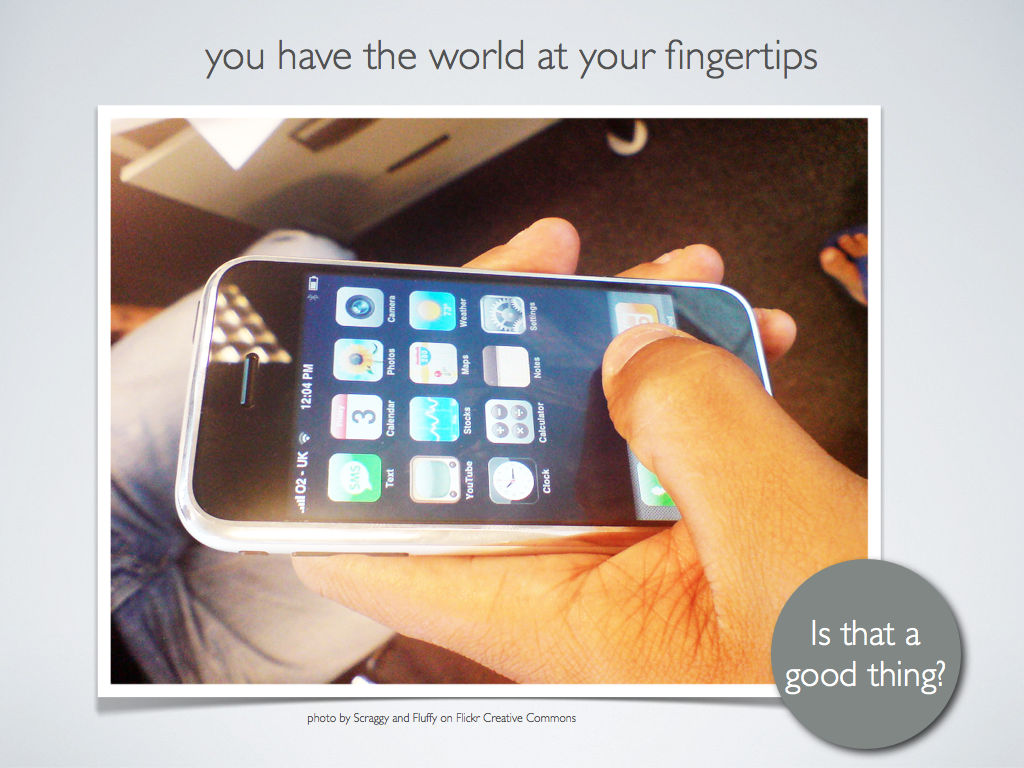
All of this 1:1 talk made me think of this great photo prompt from John Spencer.

http://visualwritingprompts.wordpress.com/2012/04/30/the-world-at-your-fingertips/

A Month of Learning

One week into my new job and I am really enjoying myself. I know things won't always be perfect and I'm certainly still in the honeymoon phase. For the time being let me live in my fantasy world. In coming into a new town and a new position I decide the best thing I can do is make my first month here a month of learning. My focus so far has been on three things.

What do schools have?

What do they need/want? 

How can I help?

These three questions have given me some insight into the school that I've visited so far. It's been fun checking schools out, talking to principals, teachers, and students about learning. Each conversation I have had we've focused on learning over devices, teaching over technology, students over standards, and future over past. One principal looked at me and said, "Well you certainly have an ambitious agenda." I don't know any other kind of agenda to have.

It's an exciting time in our district and I'm glad to be a part of it. Follow along if you'd like on Twitter. I'm using #ClarkTechTour as I visit the schools in my district. What will I learn today?

6 Things to Look Forward to in 2013

I'm back!! It feels like forever since I wrote a blog post. I ended 2012 with an interview with Arne Duncan and then The 12 Days of Dreaming Project. Both of them were a lot of fun and I appreciate all of the great feedback I've received. There is more to come with The 12 Days of Dreaming and I hope to be announcing that soon. #teaser

The end of 2012 was a crazy and exciting time for my family. I am now the Director of Technology for Greater Clark County Schools in Jeffersonville, IN. I am sure that I will be writing a lot about my experience leading a district in this position. Consequently my family and I moved two hours east to a new city.

Now that the second semester has started, we're all moved, I'm at my new job, and my kids are in their new school I plan on getting back in the habit of blogging. Every Tuesday and Thursday morning there will be a new blog on Education Dreamer. I will write most of them but I did enjoy having some guest bloggers and I hope to have some more in the future.

I just wanted to write this post to say that I'm glad to be getting into a new routine. I want to say a big THANK YOU to all of my Evansville friends, family, and coworkers. I was blessed to live in that great city for the last 7 and a half years. It was an amazing time and I learned so much during my time there.

As I move forward there are several things I am looking forward to the rest of this school year and throughout 2013. These are in no certain order.


  • Learning - Every time I have "moved up" in my career it has simply meant that I have had to become a better learning. I can not imagine what I'm about to learn this year.
  • Promoting - For me, there is nothing more fun than promoting the amazing works of teachers and students. 
  • Starting a 1:1 - One of the big task that I've been asked to do is to lead our district into a 1:1 initiative. It's going to be exciting! 
  • Failing - This ties into the learning because as much as I learn during my times of success, I often learn as much, if not more, from my failures. Plus if we are failing at some things then that means we are truly stretching ourselves. 
  • Introducing - I am going to have the great pleasure to introduce you to some amazing folks in my new district. Also, I'm going to get to introduce them to all of you. 
  • eLearning Conference - The Indiana Department of Ed has awarded us a grant to host a summer eLeraning conference. More to come on this in the future!
Needless to say, I am pumped! Thank you to all of you who have followed along in 2012! There is a lot of things to look forward to in 2013!

Dream on! 

Brett


My Conversation with Arne Duncan Part 3

Here is the final blog about my interview with Arne Duncan. If you haven't already, check out Part 1 & Part 2.

Here are the final two questions I asked Mr. Duncan with some responses from me and follow-up questions I would ask if this was a face to face interview.


1. What was your greatest learning experience and how was it measured?

Mr. Duncan: I learned the importance of early education and educating the whole child firsthand in my mother's after-school tutoring program. In 1961, she opened a free, after-school tutoring program in a church basement in a poor neighborhood on the South Side of Chicago. And from the time we were born, my brother, my sister, and I all went to my mother's after-school program every day. That experience was absolutely formative for us—and we have all tried to follow in her footsteps in various ways.

With the exception of my brother, my sister, and I, all the students in my mother's tutoring program were African-American. Despite the challenges they faced growing up in a violent, gang-plagued neighborhood, my fellow students in the tutoring program just wanted a chance to succeed. To see the extraordinary potential that every child has, no matter where they come from—that is what I learned from my mother's work—and that is what continues to drive me today.

Education Dreamer Follow-Up: I love this story and I hope that one day my three sons are inspired by my actions in the way your mother inspired you. I think back to the educators who inspire us and what we have learned from them. It's awesome that you had such a great example in your life.  You can't measure what your mother taught you and your siblings.

Follow-Up Question: Why do we try so hard to measure learning? Do you ever feel like our attempts to measure learning takes the joy out of learning? Is it a necessary evil? If so, why?

2. What's the future of standardized test? Do you ever see a time where we will have a national standardized test?

Mr. Duncan: Through the Race to the Top, our Department is supporting 44 states working to create the next generation of assessments to better measure whether students are truly on track for success in college and careers. These assessments will be an absolute game-changer in public education.

For the first time, millions of schoolchildren, parents, and teachers will have more immediate and reliable access to learn whether or not students are on-track for colleges and careers—and if they are ready to enter college without the need for remedial instruction.

Teachers will have a state assessment that tests not just knowledge but critical thinking skills and complex student learning, going beyond the existing fill-in-the-bubble tests of basic skills.
And for the first time, students will have more even footing from the education they receive, because children in Mississippi and children in Massachusetts will be held to the same standard and measured by the same yardstick.

Education Dreamer Follow-Up: I like the idea that Mr. Duncan sees the need to go beyond our current "fill-in-the-bubble test of basic skills" and look at "critical thinking skills and complex student learning". I'm going to remain skeptical of the "next generation of assessments" until I see them. I just think that measuring these things is beyond difficult. However, I am hopeful that they are better than our current assessments.

As a young teacher, before I had multiple children of my own, I would have loved the idea of students in Mississippi and Massachusetts being held to the same standard and measured the by same yardstick. Now that two of my kids are in school and my youngest is approaching pre-school, I see the need to move away from this. I'm think I'm ok with people being held to the same standards but why at the same age? My kids are 9, 7, and 4. They couldn't be more different and it would unfair of me to expect my 7 year old to be at the exact same spot his older brother was when he was 7. They are just too different from each other. I'm 32 years old and nobody expects all 32 year olds to know the same things at the same time. However, for some reason, we expect all 5-18 year olds to know the same thing at relatively the same time.

Follow-Up Question: When can we move away from trying to change assessments and standards and move towards how schools are structured? Do you think we'll ever have a national movement to allow students to move through school based on their ability and passions instead of their age?

Mr. Duncan, 

Thank you for interacting with me through emails and for taking the time to answer my questions. I hope you are reading this and I invite you to continue the dialoge with me. I would love to do a live Google+ hangout with you. I just think it would be fun and a great learning experience. Again, I thank you for responding to my original tweet back in October, and for giving me this unique opportunity. I wish you the best of luck the next four years in office. 

Dream on,

Brett


Now it's your turn again. What thoughts do you have from Mr. Duncan's responses to my questions? What follow-up questions would you ask him if you had the chance?

My Conversation with Arne Duncan Part 2

I recently had the opportunity to interview Secretary of Education, Arne Duncan. You can read how that all came about here.

Here are his responses to three of my questions with some questions/comments I would follow-up with.


1. How would you define a “successful teacher”?

Mr. Duncan: One of the best parts of my job is that I get to travel the country and meet successful and inspiring teachers from all over the country. I’ve seen successful teachers with a whole range of different kinds of teaching styles, but I’d say a few things are constant. Great teachers are committed to students and their learning. They know the subjects they teach and how to teach them. They’re responsible for managing and monitoring student learning. And teachers think systematically about their practice, learn from experience, and work together with their colleagues to help each other and improve. In fact, these are the qualities of the principles established 25 years ago by the National Board for Professional Teaching Standards.
 (I added the link to the National Board for Professional Teaching Standards.)

I would even go one further to say that in addition to being experts in their content and craft, truly successful teachers seek to leave an impact beyond just the students in their classrooms. They are leaders who share an unwavering belief that all children can learn and achieve at high levels. Great teaching is also about love - a love of learning, a love for helping children grow. I’d say that’s arguable the most important component in my definition of a successful teacher.

Education Dreamer Follow-Up : I like Mr. Duncan's response to this question overall. I think he's right in saying that "great teaching is also about love." One thing I would push back on is that I never saw myself as a manager and monitor of student learning. I always strived to be a leader and inspiration of student learning. I know it's a small change in language but I personally think it's an important shift.

Follow-up question: 1) There was no mention of standardized test scores in Mr. Duncan's definition of a "successful teacher", so how come so many states are tying teacher pay to students' standardized test scores?

2. When it comes to Race to the Top, what parts are you happiest with and what would you like to change?

Mr. Duncan: Race to the Top has gone above and beyond our expectations. Among the 46 states that originally applied, all have created blueprints for comprehensive education reform. Forty-five states and DC have adopted higher academic standards, 28 enacted laws to improve teacher quality, 16 changed laws to increase capacity to intervene in low-performing schools, 15 have strengthened charter laws, and 3 have committed to evaluating teacher preparation programs to improve classroom instruction. This has been a truly nationwide movement to raise the bar on public education for all students.

Our Department is proud of the work our 12 grantees have accomplished thus far. Race to the Top represents historic, large-scale, statewide reform. Each Race to the Top state has a four-year grant, and when all is said and done states across the country will look to these states for best practices and lessons learned.

Education Dreamer Follow-Up: I would like to hear more about how other states have improved teacher quality. His response made me think of John Spencer's post "You can't pay me to be a better teacher."

Follow up question: What research is being done to make sure that adopting higher academic standards, new laws to improve teacher quality, increasing capacity to intervene in low-performing schools, strengthening charter laws, and evaluating teacher preparation programs are actually making a positive difference?

3. What role should collaboration play in an innovative workspace? How do current education policies encourage or hinder collaboration?

Mr. Duncan: Collaboration is the foundation for effective policy. In spite of all the media attention given to conflict among education leaders, in every corner of the country there are collaborative education partnerships involving parents, educators, administrators, elected officials, business leaders, and policy makers.

A strong education system requires shared responsibility. That’s why this administration has make collaboration a cornerstone of our education agenda.

New programs like Race to the Top, i3, and Promise Neighborhoods have required partners or education stakeholders to sign-on to grantees’ applications. Each year, our senior staff has convened nationwide conferences and even international summits focused on strengthening schools and instruction through exemplary labor management partnerships. Our Office of Faith-based and Neighborhood partnerships has convened community forums across the country to shine a spotlight on existing partnerships and encourage new partnerships to improve struggling schools. And most recently, our amazing team of Teaching Ambassador Fellows—active classroom teachers who spend a year at the U.S. Department of Education—have held more than 350 roundtables with more than 4,500 teachers nationwide to create the RESPECT Project. The goal of the RESPECT Project, which is currently a $5 billion federal budget request, is to work with educators in rebuilding the teaching profession. RESPECT aims to elevate the teacher voice in shaping federal, state, and local education policy. We must make teaching not only America's most important profession. We must make it America's most respected profession. (I added the links in myself)

Education Dreamer Follow-Up: I couldn't agree more. Collaboration is the key to a successful education system. If you looked at the video from part 1 of this series, you would hear Mr. Duncan talk about all the different levels of collaboration we need to improve upon in order to better the lives of our students. I think what worries me and other educators is the level of competition in today's education climate.

Follow-up Question: Can collaboration and competition co-exist?

So now it's your turn. What thoughts do you have from Mr. Duncan's responses to my questions? What follow-up questions would you ask him if you had the chance? Mr. Duncan, if you're reading this, do you have a response to my thoughts and questions?

My Conversation with Arne Duncan Part 1

The first of October Arne Duncan sent out the following tweet.

I decided I would take my chance and respond with a few questions. Here is what happened.


I emailed Cameron and asked him if I could do an interview with Mr. Duncan through Skype or Google+.  He told me that if I sent him some questions that he would pass them on and Mr. Duncan would answer one by video and provide written responses.

After talking to a couple of folks I emailed Cameron five questions.

1. How would you define a “successful teacher”?

2. When it comes to Race to the Top, what parts are you happiest with and what would you like to change?

3. What role should collaboration play in an innovative workspace? How do current education policies encourage or hinder collaboration?

4. What's the future of standardized test? Do you ever see a time where we will
have a national standardized test?

5. What was your greatest learning experience and how was it measured?

The great thing about all of this is that it happened because I was willing to put myself out there on twitter. If we are going to make a difference in education we have to be willing to stick ourselves out there and take advantage of any opportunity that we are given. Are my five questions going to change the landscape of education? Probably not, but the conversation has to start somewhere.

It was a great honor to be able to ask these questions. Here is a blog post he released before the election where Mr. Duncan responds to some questions he received from social media, email, and regular mail. Below is the video from the post and he responds to my question about collaboration around the 3:40 mark. 


So what do you think about his response to my question? What follow up question would you ask Mr. Duncan? Sound off below and stay tuned for part 2! 

Are We Talking About Practice?


This post originally posted on SmartBlogs.
It’s been over 10 years since Allen Iverson went on his famous rant about missing practice. Yet, I’m sure a majority of you immediately thought of this clip as soon as you read the title of this post.
I basically had this same reaction about every time a teacher would get on me for not doing my homework when I was a student. I hated homework and avoided it at all cost. I just didn’t see the point. I didn’t see the point then, and I don’t see it now. As a young teacher, I assigned and graded homework because that’s what I thought I was supposed to do. Then as I moved on and grew as an educator, I assigned homework, but didn’t grade it. I’d provide answers for students to check their work, and I’d happily sit down with them and help them as needed. Finally, my last three years in the classroom I assigned zero homework assignments.
It was the best three years of my teaching career. My students were happier and less stressed. They worked harder for me in those 42 minutes a day that I had them because they knew I wasn’t going to require any more of their time than that. Also, the work that students chose to do outside of class was far more valuable than any homework assignment I had ever assigned.
When I tell people this I almost always get the same responses:
1. What about the kids who need practice?
Yes, there are students who would benefit from extra practice at home. I had a list of ways they could practice outside of the classroom each week. I’d have problems out of the book they could do, maybe a worksheet with some problems, a link to a website or sometimes a project. Each week, I was prepared to help my students think about how they wanted to improve their math skills.
If a student chose to practice something outside of class, I was always more than willing to help that student look at his or her work. The point is, I gave my students choice and made them responsible for their learning.
2. What about the kids who need to practice but chose not too?
This question almost always follows the first one. What happens when a kid needs to practice but doesn’t? The same thing that happens to a kid who wants to play a sport but doesn’t practice. Eventually, it catches up to him or her. As educators, we like to talk a lot about natural consequences. We say that when a student doesn’t do his or her work and receives an after-school detention that is a natural consequence. However, I’ve had a lot of days when I’ve not finished my work and I’ve never been forced to stay after to finish it. I didn’t study a lick for my AP calculus exam in high school because I didn’t care. I failed it miserably. So I had to retake calculus in college. That was a natural consequence, and it was the last test I remember failing.
3. What did you use for grades?
My gradebook was paper-thin, which gave me more time to communicate with parents and design amazing lessons, and it relieved me of a lot of stress. I had summative assessments designed around learning targets, and my students took those or offered to prove their learning another way. In the end, I had around six to eight grades per nine weeks. My students knew exactly what was going into my grade book, and they didn’t offer to prove they learned something unless they were certain. If they messed up a summative assessment, they could do it over again if they wanted to. I never forced it because I wanted them to want to do better.
4. Did I still have students fail my class?
Yes I did, but having to repeat my math remediation class again the next year was the natural consequence of their choices.
Homework has really been on my brain lately thanks to the creation of Teachers and Parents Against Homework Group on Facebook, John Spencer’s Week Without Homework Challenge, and this post from Patrick Larkin. I also recently wrote a blog about my kids’ life without homework.
So tell me where you stand on this issue. What’s your ideal homework situation as an educator, parent or student? If you have eliminated homework from your class, how have you done it?
Related Post

Thoughts on Homework - Survey Results

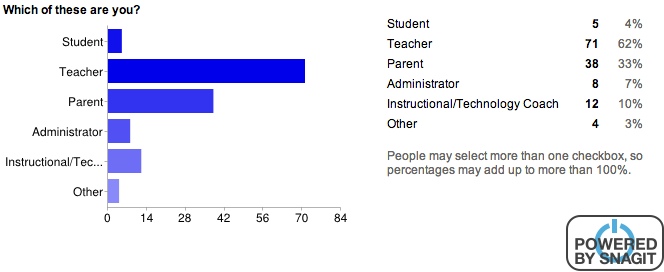
A week ago today, on September 27th, I sent out a survey with the intent to collect people's thoughts on homework. It didn't matter if you were an educator, parent, student, or a combination of those titles. I wanted to know what you thought about homework. I am so honored that 115 people took the time to fill out and survey.  I have really enjoyed reading through everyone's responses!

I want to share some different data points, some comments and data that stood out to me, and some things that I am now wondering.

I also want to share the results of the survey so you can draw some of your own conclusions.  Feel free to post your own blog about the survey results.  All I ask is that you point back to this post if you use the data from the survey on your website.

Data


What did I notice? What did I wonder?
Here are some things that I noticed, with what I wondered in parentheses.
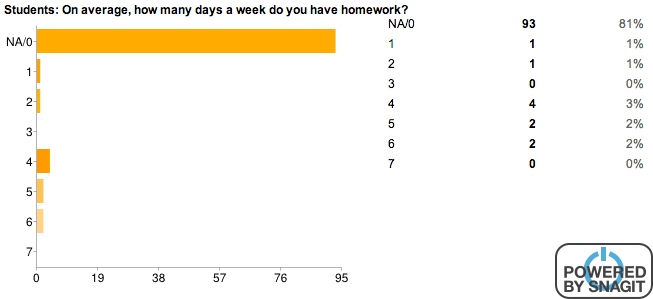
  • I didn't have very many student responses. (I wonder how I could get more student responses.)
  • The majority of people who responded were teachers and/or parents. (I wonder how many were elementary teachers and how many were secondary. I also wonder how many kids each parent had and how old their kids are.)
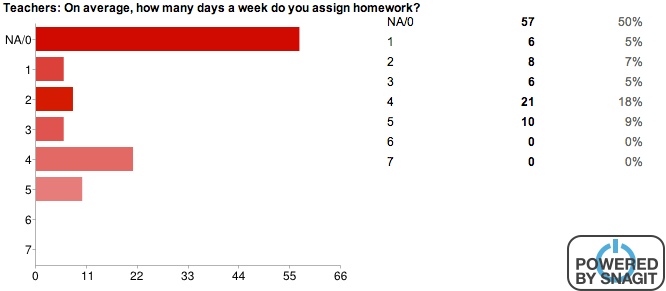
  • The majority of the teachers who filled out the survey don't assign homework. (I wonder what this says about my audience. I wonder how the survey would have been different if the teachers in my building would have filled it out.)
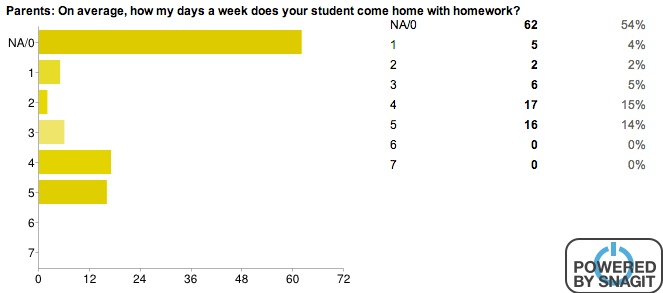
  • The majority of parents said their student doesn't come home with homework. (I wonder how many of those students have homework, but don't bring it home. I wonder if parents with less homework feel disconnected from their child's learning experience.)
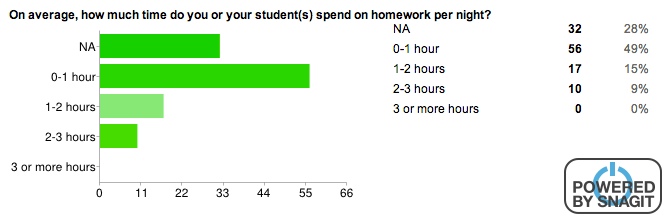
  • Most people said they or their students spend less than hour a night on homework. (I wonder how the survey would be different if students tracked their time spent on homework for a month and then took the survey.)
Comments that stood out to me.
I really enjoyed reading everyone's responses. This is a great conversation to have and I really appreciate the time and thought everyone put into this. I'll quote the responder with how they identified themselves in parentheses.

"Practice doesn’t make perfect. Practice makes permanent." (Teacher) I really like this quote. It really resinated with me. It made me think about the number of times I've had to help a student unlearn something because I sent him or her home to practice something incorrectly.

"It helps him hate math." (Teacher/Parent) I am going to assume that this person wrote that with his/her parent hat on.

"Yes as it helps to reinforce the concepts learned. Mathematics is a "doing" subject." (Teacher) I thought I'd put these back to back just for fun. I wonder if the fact that one person is not a parent had any affect on his/her response. I know my perspectives on education have changed since I've become a dad. I also wonder what subject and grade these two teachers teach.

"Have parents be more involved with students homeworks such as projects that would have to involved parents. Going to the Library to get books for an assignment,getting materials for a science project or any others project that would involve parents." (Instructional/Technology Coach) We need to rethink how we involve parents. Actually, I'll say it, I don't want to involve parents. I want to engage and empower them. I want to give them options on how they can help their students. I want to empower them to make the decisions that are best for their students. Parents are busy and I am not going to be the one who tells them how they should spend time with their children. To me involving parents just means I want compliance out of them. When I say that I want to engage and empower my parents, I am saying that I want commitment. Does that make sense?

"No. I think that too often, homework is used by teachers who don't know how to design more effective instructional approaches." (Administrator) I hope and trust this administrator is having this conversation with his/her teachers and community.

"Homework doesn't really help that's why I hate it so much. It includes printing stuff from home and written stuff. I have too much of it basically" "I do believe it does help me understand the concepts." "I think it helps improve the skills." "Sometimes teachers should have a regulated test every so offen to make sure they know what they are suppose to be teaching and giving, as far as homework." "I think homework makes us students learn a little bit better. I honestly think in-class work that is taught very well is better for us because if we have questions, our teacher is right infront of us." (Student) I wanted to end with some of the quotes from students. I really wish I had more responses from them.

Conclusion

This is a conversation that we as educators should be having with each other, our students, and parents. Parents, don't hesitate to talk to your child's teacher about this issue. Never apologize for advocating for your child. Remember he may be our student but he's your child. If there are any students out there reading this, try to work with your teachers and parents. Let them know your needs so they can help. 

When you look through the survey results yourself you will see that there are some great thoughts on how we can improve our homework practices. Let's move beyond dreaming about how we can make things better and put things into action that will benefit the lives that walk through our classroom doors.


So here is the spreadsheet of all the responses I receive this past week. You can also find the spreadsheet here.


Thank you again to all who took time to fill out the form and to those of you who shared out the survey! I have the best PLN ever and it's growing every day! 

Please share with me in the comments what you noticed, what you wondered, or any other thoughts you had on the survey results! 

Related Post
My Kids' Life Without Homework     Dear Standardized Test        

Three Keys to Leadership

I'm not sure it can be overstated how important leadership is. Leadership is what tips the scales in the workplace.  A good leader can take a bad situation and turn it around and a poor leader can be handed the best situation and turn it into a disaster.

Bill Bradley once said that leadership is unlocking people's potential to become better. I couldn't agree more with his statement. The question is how do leaders do this? What are the characteristics of a good leader? Now obviously there have been books and books written about what makes a good leadership and I'm not naive to think I'll cover everything in one blog post. However, I believe I have identified three keys to being a good leader.

Like a lot of my blog posts, it all started with something I tweeted the other day.

Now I would like to expound on that thought a little bit more by discussing why I think those traits are important, why leaders struggle with them, and how we can develop them.

Willingness to Empower

Why it's important:

The best way to lose power is to try to hold onto it. The word empower means to give authority to somebody else. Good leader will work to find ways to hand their authority to those around them. They will do this for a couple of reasons. One is because the recognize we can't do this alone. I don't care how big or small the job is, we are all better when we work together. Another reason is because when people are empowered, they feel energized. Think about the word "em-power". If we don't empower people, then they will feel powerless. If the people who work with us feel powerless, they won't work with us, yet alone for us, for very long.

Why it's difficult for leaders to do:

The reason why it's difficult for leaders to empower their employees is because when we empower people we feel like we are losing control and become less needed.  Control is an illusion. A leader will only have as much control as they are willing to relinquish. Also, a leader must ask themselves this question, do you want compliance or commitment? Micromanaging might increase the amount of compliance you get from those under you. By empowering those around you, you will increase the amount of commitment you from those who work with you. Also, it is a lie that the more responsibility you hand off, the less you will be needed. In fact, the opposite is true. Empowering those around you allows you to grow in influence and you become more important.

How leaders develop this trait:

In order to develop this trait, you must first have a clear direction where you want to go. A leader can not empower people if they don't know what they are empowering them to do. Once a clear vision has been determined, then it is easier to delegate responsibilities to those around you. Also, a leader must understand the strengths and weaknesses of those on his or her team. When you have a vision and understand your team's strengths and weaknesses, then a leader can feel comfortable empowering the people he or she works with.

Willingness to Trust

Why it's important:

Change will not occur without taking risk. If people are going to take risk, then trust has to be involved. They have to first trust themselves and their decision making.  However, if they don't feel those leading them have trust, then will be hesitant to take risk. Even if they have complete trust in themselves. Also, it's important on the leader side of things as well because if you don't trust those you work with then you will spend all of your time worrying about what they are doing or micromanaging every decision.

Why it's difficult for leaders to do:

There are potentially several reasons why a leaders struggles with trust. One could be that the team they have was one that was handed to them and not one they put together themselves. Another could be because their boss doesn't put trust in them and they have learned not to trust those around them. Also, leaders feel, in the end, it's their name at the top and are not willing to put their reputation in the hands of another person.

How leaders develop this trait:

First of all, a leader must be willing to be a risk-taker themselves. Putting your trust in somebody is a risk but it is one that reap great rewards.  Leaders must be willing to accept this risk. Even if the team is one that was handed to the leader, by placing trust in them a leader will unify their team. Willingness to trust is one of those traits that you can only build by diving in and taking the risk.

Willingness to Release Control

Why it's important:

A leader can't do it all effectively. There is almost no task out there that won't be accomplished quicker and better without a team. One of the main role's of the leader is to be working on the next steps for their team. A leader can not be working on the future if they are too busy controlling the present.

Why it's difficult for leader to do:

Like building trust, it can difficult to release control if a leader feels like it's his or her butt on the line. Also, when leaders release control then they must also be willing to put others ideas ahead of their own. This is where pride can rear it's ugly head. Self-confidence is a great trait to have but pride is a destructive trait. A leader can't release control and be prideful at the same time. Leaders, at one time or another, will have to deal with pride.

How leaders develop this trait:

First of all, leaders must reflect on how they like to be lead. Most likely they moved into leadership because somebody released their control on them and allowed them to shine. Fish will only grow to the size of the tank we put them in. The bigger the tank, the bigger the fish. The bigger the body of water, the less control we have. If leaders want their team to grow, then they will have to eventually release control. Releasing control is a decision and it's one that is vital to the growth of leaders and their teams.

It's time to hit the comment section up! What traits do you look for in a leader? How do you develop the ability to empower, trust, and release control? 

Education Dreamer

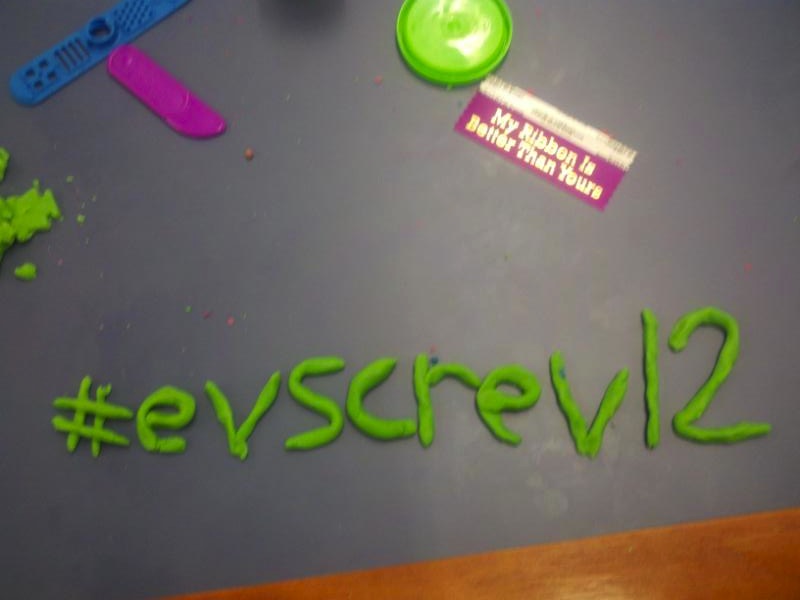
Going from better to different! #EVSCREV12 #edudreamer

Today we kicked off The EVSC eRevolution in Evansville, IN.  This is my school district's anual technology conference.  It started off the year our high schools went 1:1 and has grown over the last 3 years.  This is our 4th conference but for the first time we opened it up to others outside our district.

These are just some thoughts from day 1 as I unwind!

Registration:
I personally checked in over 200 people as they arrived at the conference.  I loved the instant energy that I felt as these teachers walked through the doors.  It's always exciting to see educators come ready to share and learn!

Being a connected educator:
The first session I presented today was about being a connected educator.  Tom Whitby and Kristin Daniels joined us through a Google+ hangout.  We had a great discussion with our attendees about what it means to be connected, why we should be connected, and how to become connected.  Tom has so much passion about connecting people.  I enjoyed watching people immediately sign into the Educators' PLN Ning and sign up while he was talking.  Kristen has a great story about how she first joined twitter, tweeted once, and didn't tweet for about two more years.  Then she started following a hashtag at a conference and discovered the power of becoming a connected educator.

Sessions like this always help me to see that more and more teachers are no longer the keeper of knowledge but the connector or knowledge.

Keynote with Will Richardson

There is so much I could say here that this probably deserves it's own post at some point and time.  First of all, Will is a great person and just a lot of fun to be around.  I had the pleasure a few months back of interviewing Will for a blog post and I got to spend some time with him the night before the conference.   He is passionate about not just making education better but making it different.

A few thoughts from Will's keynote:

There were technical issues (figures) and we never did get his slides up on the projector.  However, he handled it like a pro and gave his presentation flawlessly!

We have to look at what our endgame is for public education.  If all we are concerned about is passing test then we need to seriously rethink school.

How do we define learning? Ask 50 people that question and you'll get a wide variety of answers but most of what we define as learning isn't assessed on standardized test.

"If we don't assess what we value, then we'll end up valuing what we assess" - Will Richardson

Educators need to be able to Learn, Unlearn, and Relearn.

Learn: Teachers must be seen as learners.  Do our students know how we learn?

Unlearn 3 things: Curriculum delivery, assessments, and competition.

Relearn: Curriculum is everywhere, try an "open network" assessment, and cooperate!

"I want my children to be found by strangers online." - Will Richardson

Will was speaking to the fact that when you get connected you learn from people all over the world.

Screencasting 101

Brian Bobbitt and I did a session about screencasting.  It was fun to discuss with teachers about the many uses of screencasting.  It's not just for flipclass and has many application.

Digital Detox

I spent the rest of the day in our digital detox station.  This is an area of the media center that was inspired by a blog post from John Spencer.  It's pretty simple, plug in your devices into one of our charging stations, have a seat a table.  The tables had plato, board games, origami, puzzles, and legos.  I sat down with three other teachers, played with plato and just connected with these educators.  It was the most relaxing part of the day and one of the most enjoyable parts of the day.


Conclusion

This is an exciting time to be an educator!

We have to be more than better, we have to be different.

We must continue to engage people (educators, parents, politicians and the community) in conversations about learning and the value of school.

The change that we need in education is not easy but it's not impossible.

What's Killing Education

*Disclaimer* This is kind of a rant that began to form in my head after this week's #edchat

We have a major problem in our society and our country and I think it is killing education.  No, it is not standardized testing.  I am not a fan of standardized test, and they certainly do more harm than good.  However, standardized test are simply a tool.  With any tool, we must ask ourselves what is the purpose of the tool?  The purpose of the tool is to determine the "success" of the school and to rank schools and individual teachers.

This is what is killing education: our obsession with rankings.  It's true, we are obsessed with rankings.  They are everywhere!  Everything and everyone is constantly being ranked!  It's in our advertisements. "Choose the number 1 toothpaste in America".  It's in our sports (BCS, AP/Coach's poll).  It is everywhere.

And I must admit, I get pulled into this obsession with rankings all the time!  I'm a huge Indiana basketball fan.  All we can talk about right now is how IU is ranked #1 in the nation next year and they are 5+ months away from playing their next game!  I love movies and if I'm on a website and I see some kind of "Best 10 (fill in the blank) movies ever" I have to read it!  I can't help myself.  It could be "The Top 25 Best Alien Cat Movies" and I would read it!!  I've never even seen a movie about alien cats.  I'm the worse at the end of the year and everyone has their "best of 2012" post.  Just lock me up and take away my Macbook.

I can think of very little good that comes out of ever ranking anything.  However, I can think of several reasons why we should be against rankings, especially in education.

1.  It Starts Arguments

I don't care what you are ranking, you will never find a perfect way to rank things.  Just play along with me.  Name the top 10 Worse Kevin Constner Movies of All Time.  I know what you're thinking, "Only 10, I can name 20." However, that's my point (It's The Postman by the way).  All of you reading this would have your own separate opinion based on your likes and background.  I remember when Rolling Stones came out with the best 100 guitar players ever and hearing people debate it.  Even on ESPN radio, they debated it because that is the purpose of rankings!

Rankings are designed to start arguments and divide people!

Do we really want this in education?  Do we want "The Top 25 Middle Schools in America"? All it will lead to is arguments and divisiveness among people who felt like their school should have been on the list.

I know I've heard multiple times when a school or a teacher is being advertised as "one of the best in America" is, "yeah, but let them try that with my kids".  Instead of wanting to learn from them, teachers resent them because of their rankings.  Now, that is obviously the wrong attitude to have, but those are the facts.

2.  It incites a sense of competition over collaboration.

I worked this year with a team of technology integration coaches.  There were fifteen of us at the beginning of the year but towards the end of the year there was the sense that budget cuts were going to have to force us to cut our team down.  My boss was given the terrible task of making us go through this little "re-interview" process and rank us.  All year long we had worked together as a team.  All year long we had each other's backs and helped each other.  However, I'll be honest with you, as I was with the people I work with, as soon as we were told we were going to be ranked 1-15, I immediately started looking around the room to size up my competition.

This is what rankings do to people.  They encourage competitiveness over collaboration.  Again, is this what we want in our schools?

If we continue to try to find ways to rank teachers, and go a step further and pay teachers based on their rankings, then we will push education in a direction that, I'm afraid, will ultimately be its undoing.

The test isn't the problem.

At the close of this post I want to reiterate that standardized test are not the problem any more than a cell phone is the problem in the classroom.  Both our tools are the problems come from how they are being used.  If standardized test were just a tool to use as one data point for our students, and they were not tied to our school performance or pay, then I wouldn't have nowhere near as a big of problem with them as I do now.

I speak as both a parent and an educator when I say that we have got to stop all of this use of standardized test (or any tool) for the purpose of deciding the success of a school or the effectiveness of a teacher.  I am all for being accountable and being evaluated but there will never be a one-size-fits-all solution to education.

Rankings build up the few and defeat the multitude.

I'm interested in seeing our schools become a community of learners, a place of collaboration, and personal/professional growth.  In education lets focus on building each other up, and leave the rankings to the sports, music, and entertainment industries.

A Conversation with Will Richardson

A couple of weeks ago I had the honor of sitting down and having a conversation with Will Richardson via Skype.  Will was gracious enough to allow me to interview him for this blog post.  Now, as a disclaimer, I was a math major in college, I taught math for nine years before becoming an eLearning coach, and have no idea how to conduct a real interview.

I sought out Will for a number of reasons.  I first heard Will speak at Solution Tree's Author Speak in Indianapolis.  I have since followed him on twitter, and read his blog post on a regular basis.  Will is also going to be a keynote speaker at my district's regional eLearning conference in July. He recently wrote a blog post about "Bold" schools and it was this post that inspired me to reach out to him to find out more about how we can move from "Old" schools to "Bold" schools.

For the sake of this post, all the questions will be in bold, W = Will's answers, B = my thoughts/responses to Will's responses.


With all of the issues facing education (i.e. testing, poverty, digital divide, budgets), where do we start when transitioning from an "old" school to a "bold" school?


Will:I'm coming to the conclusion more than anything else that the starting point has to be two fold.

1: Bringing everyone to the point where they have a pretty clear understanding of the context of what's happening right now and by everyone I mean everyone from the students, parents, teachers admins to the cafeteria workers and custodians. What I find still after speaking for 7 years IS that I go to a lot of places and people look at me like I have three heads when I say, "hey, things are really changing from a learning and education stand point" because they don't realize it.  They don't see it. They don't get the big picture sense of the challenges that are presenting themselves to schools right now. There is no question that schools are in for a huge challenge over the next 20 years.

If the values we have in schools continues to be the way we have currently defined, which is passing some state test, and getting to all those common standards, then I really think that technology will be able to do that better than teachers at the end of the day. If it's about passing algebra or passing some content based science test then there's going to be technology that is going to be able to personalize it for students that cater to their strengths and remediate their weaknesses in a way a teacher can't because he or she has 30+ kids in their classroom.

This is the big challenge that not too many people have come to grips with yet.  There are a lot of people in this country that want to do that.  They want to define education the way it's always been defined and then use technology to deliver it in a much more personalized way.

So we need to redefine our values.  I know that our value is not in content any longer and we spend a lot of time on content. We have to have conversations with people in our communities to make sure that we are clear what the real value of school is right now. What I think the real value of school is right now is not about content knowledge but about helping kids to become learners, helping kids to change the world, making school authentic and real world.  Where what we ask the kids to has meaning and importance.  Getting kids ready for the real world.  Spending our time developing disposition and literacies in kids that will allow kids to flourish in a world where they can learn anything they want, whenever they want.  That's the big difference, they don't need to come to us to learn this stuff anymore.  What they need to come to us is to learn how to learn it.  We're not spending enough time on that because we're still mired in this content knowledge, delivering the curriculum model.  Which was understandable in a time where teachers and knowledge was scarce but that's not the case anymore.

Brett: I found myself on that day, and still today agreeing with so much of what Will and I talked about.  If we allow the direction of education to continue to be centered around testing and success be defined by how our students do on a test, then one day we will be replaced by technology.  If all we are doing are giving our kids "hoop jumping" skills, then we are doing our students a huge diservice.  Think about when you learned how to learn.  When did that occur?

Our students don't need somebody that can just feed them information, their phone can do that, Khan Academy can do that. What our students need are teachers who can help them learn how to learn, how to find their niche in this world, and how make a difference.  I like to think of teachers as the chief learners and also as a talent scout.

I understand why so many teachers teach to the test, because that's how we are evaluated.  I also understand the fear many of us face when we start to move away from that style of teaching.  Which lead me to my next question.

In the age of accountability that we live in, how do you help teachers combate the fear of moving away from teaching to the test?


W: Our challenge as individuals right now is that we live in this transition moment where we're going to be required to do two things at the same time.  One thing is we are going to have to make sure kids can pass the test and meet all those traditional objectives because everyone is asking us to do that and can't not do that.  We can't just walk into school tomorrow and say that we're not worrying about the test because we don't think it's a real indicator of who you are as a learner and all of those arguments we have against the test. In the end, we still have to help kids pass the test because that's the current expectation.  The other thing we have to do is we have to do the thing you and I are talking about even though nobody is asking us to do it.  There's no test for "are you a learner?" "are you self directed?". There's not test for these other things, yet those are the skills that are more important than most of the stuff that we are delivering in a content sense in the curriculum.  I may be way out there on this but I really think that 75% of all the things we ask every kid to do in schools is ridiculous.  That's not to say that some kids in schools need or want every part of the curriculum but the idea that every child needs ever part of the curriculum is ridiculous.  What every child needs is the disposition to learn, to be patient problem solvers, to understand and embrace failure.


What I say to teachers is A) welcome to it, sorry, but you're in this moment of big change. There's not much anyone can do about it.  In the end, you have a choice, you can stick in it and help your kids navigate through it or you can go do something else. That is a choice you have. B) If you really want to understand this stuff, and get to the point where you understand passing the test and learning how to learn are not mutually exclusive.  Then what you have to do is you have to put the work in for yourself.  You have to take the time to develop this disposition in yourself that you can learn whatever you want, whenever you want, with whomever you want around the world.  Then to really understand that on a practical level so you can bring that into a classroom in a way that accomplishes both goals of passing the test and learning how to learn. Is that hard to do?  Yeah, it's really hard to do. I'm at the point now where I don't think we have a choice. I don't think there is an option.


B:  To me, this is exactly where we are at.  Unfortunately, we are caught in a time of transition.  I honestly think, that in 10 to 15 years from now we will have moved away from being test-centered.  However, we are in the middle of this great change and we have the amazing opportunity to leverage technology in a way that helps students pass a test, and still provide a place where kids can learn how to learn, become patient problem solvers, and understand and embrace failure.

You mentioned earlier that the place to start is two fold.  The first is starting conversations with everyone in the community about where we are at in education, what is the second?


W: To change your personal practice around learning.  Each of us as individual learners need to fully understand what learning looks like in these context in order to become more effective teachers, if that's the right word.  Even though we're teachers and that comes with a lot of baggage that I'm sure is good thing right now.  Because being a teacher implies I have something to teach you. In most people's brain that plays out that I have some content knowledge or expertise to teach you.  Where I think we (teachers) need to be learners first and be the learning experts in our communities.

B:  This point speaks to the idea that I've always believed; if you want to see great change, you must first start with yourself.  If we are going to change the way education is perceived, and believe me, we will, then we must first start by changing ourselves.  We must change the way we learn and we must change our role in the classroom. No longer are teachers the keepers of knowledge but we are all learners.  There are ways to make sure our students pass the test and still provide authentic learning environments for our students.  It is certainly not easy but there are schools that are doing this. Which lead me to my final question for Will.

What is the most successful school you've seen and why have they been successful?


W: For me it's a pretty easy question, it's Science Leadership Academy in Philly with Chris Lehmann. He's just doing amazing stuff.  All the 9 things I listed as being "bold" are all things Chris is doing.  He's created a model for what schools need to look like.  The key word there is "created".  He hasn't moved the school to the model.  He built the school in the model.  So, the question is, how do schools that are already established get there?  That's what I'm trying to find out.

If you're looking for a school that was built to be a "bold" school, then it's Science Leadership Academy in Philly, no question. They're a 1:1 school, they are problem based, inquiry based, they throw huge questions at their kids, they don't deliver much of an education at all, kids are creating their own curriculum, and teachers are there to facilitate and lend their expertise.   They do that subtle dance to take that learning environment and still make sure they pass the Pennsylvania state test but also walk away with this global network learning context.  The real strength of the school is that the adults are all learners.

B: This is exactly the kind of person I want to be and the kind of school I want for my own kids.  I think the school I send my kids to is getting there.  They aren't there yet, but they are getting closer every year. I invited will out to visit their school and I hope he gets to come.

I think the key to all of this, as Will pointed out, is getting everyone on board.  Throughout the conversation and after reflecting on it over the past two weeks, I wonder if it's just easier to start a new school with people who already think this way as opposed to trying to turn a school around.  I am with Will on this journey to find out how we can take established, traditional schools, and turn them into schools that better serve our kids.

I was honored to interview such a great educator.  I leave you with one more quote from Will as we wrapped up our conversation.

W:  We (teachers) really have to learn how to take ourselves out of this process as much as we can and be the guides, the learning experts, the inquiry experts, the ones who know how to ask great questions and keep motivating kids, but are not delivering much of anything at all.

From Innovation to Implementation

I sat in a meeting recently where presenters from NCRTI were talking about moving from innovation to implementation.  Innovation is defined as a new idea, method, product, etc.  Implementation is defined as the act of accomplishing some aim or executing some order.  While we're at it, lets go ahead and define innovative as a person or business that introduces new ideas, methods, products, etc.  

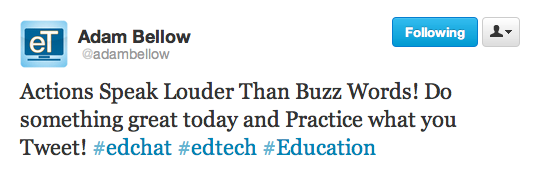
I hear a lot of talk about schools, principals, and teachers wanting to be innovative.  However, I contest, that we must be much more than innovative.  Just using the latest teaching strategies or the newest technology does guarantee success.  As Adam Bellow says, "Actions speak louder than buzz words."


Look at the difference between the definitions of innovation and implementation. Innovation is simply the new, where implementation is the act of accomplishing some aim.  It takes more than a cool tool to do something great, but you must accomplish something and have aim.  How do you get there?  How do you move from an amazing idea to amazing results? Here are things our presenters touched on with my thoughts.

1.  You Explore and Adopt/Reject

I think this first step speaks directly to the Adam Bellow tweet above.  There are some amazingly awesome ideas out there when it comes to education.  However, we cannot just randomly pick the "flavor of the month", tell our teachers to "do it", and hope for success.  We must look at the innovation, whether its a new teaching model, piece of technology, or an app, and explore it to make sure it's the right choice for our students and our school.  I am not the first person to say this and I won't be the last, but we have to make sure the things we are implementing will bring us closer to what we are trying to accomplish.  I have seen many great websites, apps, and pieces of technology in my job and have instantly thought about how cool it would be to use such a tool in my work.  However, when I got over the initial excitement and began to think about it's usefulness, I realized that I was fine without it and it didn't fit the needs of my class.  Set goals, and then find the innovation that will bring you closer.  Remember, implementation is about "aim".

2. Planning

If you think we run through step 1, then you better not blink or you'll miss the planning stage.  We have a tendency to fall in love quickly with the new and then just throw it out there and hope it sticks.  Success does not happen by accident, you have to aim for it.  When moving from innovation to implementation, the first thing you need to plan for is what and how you are going to assess the success of the innovation.  Just like a good teachers decides how they are going to assess what they are teaching BEFORE they teach it, those who are going to introduce something new to a staff must do the same thing. You must decide what it is you are looking for and how you are going to measure for that success.  Secondly, you must decide how you are going to support those who are implementing the new concept or tool.  Then, once you have decide what you looking for, how you are going to measure it, and how you are going to support it, you plan on how you are going to introduce it.  Finally, plan on what the innovation looks like when it is fully implemented.  A good teacher wouldn't give his or her students a project without showing them the rubric by which it was going to be graded and giving examples.  Design a rubric of innovation that spells out what you are expecting this innovation to look like fully implemented in the classroom.  Then stair-step down a few levels to show teachers where they can start and how to build up to full implementation.

I personally believe you must have these things in place before you introduce the innovation to the staff because it will help you get buy in.  If the staff see that you and your team have done your homework, picked an innovation that serves a purpose, set a goal, designed adequate tools to measure success, planned to support, and have spelled out what your expectations are along the way, then they are more likely to buy in.  Without buy in, I don't care how good the innovation is...it won't work.

3.  Implementing

With your plan in place, you can now move forward and implement the innovation.  This section becomes a lot shorter because you planned well before you got here.  When you get to this point, trust the plan and stick to it.  We deviate and allow things to slide during the implementation stage if we have not adequately planned.  Don't compromise any part of the plan if it's going to undermine the integrity of the innovation.  Now I'm not saying you can't make adjustments on the fly, because you certainly can and will.  However, there probably won't be any sweeping changes to the plan, if you have adequately planned.  Also, be open, honest, and realistic throughout the implementation stage of the innovation.  Know when to push ahead and know when to slow down.  Putting something new into place is a delicate process and timing is everything.  Implementing is not like downloading an update to an app.  I don't have to convince my iPad that the latest update to GarageBand is a good idea.  However, education is very personal and you can almost always expect to have push back at this stage in the game.  Push back is not a negative thing.  It's through resistance, that we gain strength.

4.  Continuously Improve

I don't care how well you explored, planned, or implemented, nothing is ever perfect the first time through.  This is why you planned to assess.  This is why you planned to support.  This is why you planned to implement.  So that while you are working through this process you are making adjustments as needed.  Of course, this is also the time where you can decide if the innovation was the wrong choice and go a different direction.

Throughout this blog post I have used the word "you".  However, do not think I believe the journey from innovation to implementation occurs just because of the work of one person.  Every step of this process must be a team effort.  Throughout the process of moving from innovation to implementation I encourage you to include all staff, students, parents, and the community.  Great things occur when we when we all work together for a cause greater than ourselves.

Professional development is all about gradual release.  When you move from innovation to implementation, that which is innovative becomes an imbedded tool in the teachers' tool-belt. Unfortunately, for too long it has been more like "catch and release".  We bring educators into a room, catch their attention with something shiny, and release them into the wild.  Gradual release is a longer process that takes patience and dedication, but in the end everyone benefits.

Good Principal = Good Teacher?

Yesterday I had a great conversation on twitter with two amazing educators, Josh Stumpenhorst (@stumpteacher) and Jason Bednar (@J_Bednar).  The conversation started off like this:
This conversation went on for several more tweets and Jessica Johnson (@PrincipalJ) even joined in at the end.  I just thought it was a very interesting question and I thought I'd give all of you a chance to weigh in on it.  So, do you think that in order to be a good principal, you had to first be a good classroom teacher?

I personally think that most good principals were, at one time, good classroom teachers.  However, I also think different people have different gifts and I think it is possible to be a great principal and not a good classroom teacher.


What do you think?

Dear Standardized Test *Updated*

*UPDATE* It's ISTEP week for my son and everyone else in the state of Indiana. Last night he asked me, "Dad, do you think I'm smart enough to pass the ISTEP?" I responded, "Micah, you're smart no matter what that test says." Micah smiled, hugged my neck and said, "Thanks dad."

Let's remind our students during this testing season that nobody is ever defined by one event or one test, but are defined by the sum of daily choices we make throughout our life.

Here is the original post:

*Warning* This blog may be more of a rant than anything...

Last night I was putting my three boys to bed and we were saying our nightly prayers.  As our custom is in my family each boy, ages 3, 6, and almost 9, each have a turn to pray about whatever they want.  My three year old prayed that he loved his brothers and playing the wii.  My six year old prayed about school and to help him and his brothers to be good.  Then my oldest, who will turn 9 on February second, prayed a prayer that made me send out this tweet as soon as we were done:
Now, I want to say that I don't find this prayer a reflection of my kids' school.  I absolutely love the school they attend.  They have strong PLCs that lead to innovative instruction.  They have no textbooks,  no homework, and no grades.  My kids love to learn and have grown tremendously at their school.  I plan on blogging about the school at some point in the future because they are a groundbreaking school.  However, at this time, I'd like to finish my rant.

The thing that I didn't tweet last night was Micah's six year old brother's response.  He looked at Micah and asked if he would pray for him and Levi so they would pass the test too.  It was such a sincere moment and Micah went to work and prayed that Nathan and Levi would pass the test too when they were his age.

I can not begin to tell you how sad this made me.  First of all, I do not think my oldest will have any problem passing the test this year.  He is a smart young man who loves to learn.  He was given a four book series for Christmas from his grandma.  Each book is close to five hundred pages and he has read two of them in the last 3 weeks for a total of over 900 pages.  Not to mention the books he's checked out from the library during that time and yes, I'm bragging.  Secondly, I personally don't care if he ever passes a state exam because they will never tell me anything I didn't already know about my child.

What bothers me is how much he cares about the test.  Again, it's not his school's fault he cares so much, all they have done is shared with him the facts of the exam they are forced to give.  Now my son isn't worried about learning, he's worried about a test and if he'll get to go on with his friends to fourth grade.  Now my middle child isn't concerned about the soil he was telling me he learned about at school, he's praying that he'll pass a stupid test in two years like his big brother.

This is where we are at today.  The standardized test programs of our current education system do nothing but bully the kids they test.  This is the definition I got when I googled the word bullying.


I can not think of a better definition for standardized test.  How depressing it is to think that all the work a student does throughout the year comes down to a few days of testing.  However, this is how our society is today.  Ask Kyle Williams of the 49ers or Billy Cundiff of the Ravens.  All of their work was brushed aside and both received death threats because of one day's work.  Do we want to mirror that kind of thinking in education?

To my son, that's what the IRead and ISTEP are, a school death threat.  In a time of his life when he should love learning, enjoy his friends, play games, and think girls have cooties, he's praying to God that he passes a test.

Dear Standardized Test,

Thank you for ruining our nightly prayers last night.  Thank you for using your superior influence to intimidate my son and to force him to do what you want.  Thank you for causing him to worry about the future when he should be enjoying the present.

                                              Sincerely,

                                                Brett Clark