Showing posts with label Professional Development. Show all posts

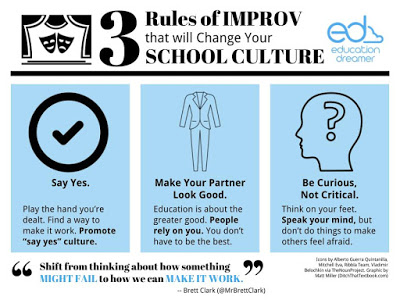
The 3 Rules of Improv That Will Change Your School Culture


There are some meetings that you find yourself in and you're just counting down the minutes until it's all over. The presenter knows you don't really need to be there, you know you don't need to be there, and you probably couldn't recall anything the presenter said during the meeting. Then there are those meetings when you're like Richard Dreyfuss in Close Encounters of the Third Kind.

"This means something. This is important."


Well, as I recently set in an Association of Talent Development meeting, I had such a moment. I was about 5 minutes into the meeting and I knew I was participating in an event that was going to add another tool in my toolbelt in terms of professional development. 

The session was led by Kate Bringardner from The Speaker's Studio in Louisville, KY.  They offer a variety of coaching and training options and this event was centered around improv. I thought we might end up like an episode of the Office, which was totally fine with me, but I learned way more than I honestly expected going into the night. 


Kate and her co-presenter took us through a variety of improv exercises. They were fun, funny, and made you step out of your comfort zone. If I were to describe them you might say that those were some nice ice breakers. However, these were much more than just some games because they were centered around their 3 rules of improv. It was these 3 rules that I've been pondering on ever since that meeting and it's these 3 rules that I think many of our school districts lack. 

1. Say Yes

The first rule of improv they dropped on us was to say "yes". Improv can make you uncomfortable because you don't really know what could happen next.  Sounds a lot like a day in the life of a teacher. One thing they said over and over again at the beginning was, "the only way to lose is not play." See, saying yes isn't about being a "yes man" or a "yes woman". It's about playing the hand you're dealt the best to your ability. We learned really quickly that whatever you think might happen next was not going to happen next. 

In our schools we need a "say yes" culture. We all need to say yes to the hand we are given and figure out how to make it work. It really reminded me of somebody I've worked with over the years. When I first met this person it always seemed they knew why what we were trying wouldn't work. It didn't matter the idea, they were going to shoot holes in it. One day we were having a conversation about it and I asked that person to shift their thinking. It's not that they wanted what we were doing to fail. They really were trying to help by finding the weaknesses in the plans. However, they were being shut out because they were being perceived as a negative person. Instead, I asked them to shift from thinking about how something might fail to thinking about how we can make it work. 

That's what saying yes is all about. It's not about adopting bad policies to go along to get along. It's about finding a way to make things work. 

2. Make Your Partner Look Good

I immediately thought of our good friend Amber Teamann. The first time we had her to our eLearning Conference she told a group of principals that her rule for her staff is that it's their job to make her look good and it's her job to make them look good. Simply put, you've got to have each other's backs. 

There is hardly anything that fires me up in education quicker than this notion of competition inside of education. If all you are worried about is beating some high stakes test, out performing the neighboring school or school district, or being the best teacher in the hallway, then I'm sorry, but that's pretty small minded. Education is about the greater good and we must resist the societal pressure to turn it into a competition.

Some of our improv activities got out of hand real quick. We said some ridiculous things and whatever was said, you just had to go with because your partner was relying on you. There is something freeing when you take the focus off of your own performance and you put it on your teammate's performance.

3. Be Curious, Not Critical

Some of the other benefits of improv, and maybe they're ones people think of first, are it forces to think on your feet and it gets you comfortable with speaking your mind. These are two things that we all need more of in our individual classrooms, our school buildings, and our learning community as a whole. 

As educators we've got to be able to think on our feet. There are hardly two days alike. Even the year that I only had one prep and I taught the same lesson five times a day, I never had two identical lessons. Improv is a great way to help hone that skill and to do it a fun and engaging way. 

However, we've got to do more than to think quickly, but we've got to be able to speak up. Employers will tell you that they want you to speak your mind. At least most of them will tell you that. All of us as classroom teachers have encouraged our students to speak out when they have a question and don't understand something. We also know that more often than not, students (and adults) would rather sit in silence and be lost than to speak up and feel stupid or dismissed. We feel this way when we are entrenched in a critical culture and not a curious one. 

Like I said earlier, our improv activities got out of hand in a hurry but they kept flowing as long we stayed curious and not critical. The same can be said of our schools. People don't speak their mind because they are afraid. They are either afraid of their ideas/thoughts/questions are wrong/bad/stupid
or they are afraid of how they will be received. 

If we find ourselves in an improv situation and our partner(s) starts throwing out ideas that make no sense to us we will be faced with a choice. Our we going to be critical of that idea and shut down the conversation or our we going to be curious, make our partner look good, say yes, and figure out a way to make it work. 

Final Thoughts

So I think I want to adapt this into a keynote or breakout session and add it to my menu. I think it would be a cool and fun session to do with a room full of educators. There are some pretty awesome large group improv activities you could start off with, then launch into the conversations around these 3 rules of improv, weave in some moments where you bring up some audience members for improv activities, and I think you'd have a fun, thought provoking keynote. 

What do you think about these 3 rules? Which rule(s) do you think you have in your school and which rule(s) do you think are lacking in your classroom/building/district? Would you enjoy a keynote built around improv and would you find it impactful?


What to Expect When Expecting Technology #edtech #edchat

I am amazed at how much the process of going 1:1 has felt like my like first year teaching but not for the reason you're thinking. You see, aside from taking on 7th grade math students in Lafayette, IN that year, my wife and I also had our first son. There are amazing similarities between starting a family and bringing innovation into the classroom.


Preparation


There's a reason why What to Expect When Expecting has sold millions of copies! People want to learn from other people what it's like to have a baby. We would rather learn from the successes and failures of others to help us maximize our chances at success. This is why, if you are expecting to go 1:1, BYOD, or some hybrid of the two then you've got to do your homework.


Sharing the News


When you tell people you're pregnant, they always ask the same two questions. Are you having a boy or a girl? When are you due? In other words, what device(s) are you going with? When is your rollout? Unlike having a baby, these questions don't answer themselves. Your school has to figure out what device(s) you are going to adopt and/or if you’re going BYOD. Then you've got to decide what grade level(s) and when this will start.


Some of your closest friends/relatives might also be brave enough to ask you, "Why are you having a kid?" This is one question you will absolutely be asked that question if you are going 1:1 in any capacity. Why? Knowing the answer to this question is perhaps the most important part of your initiative.


Here is my answer to that question:


For us, leveling the playing field between those with access to technology and those without access by going 1:1 allows us to focus on what's really important, which is the learning that takes place on a daily basis in and out of our classrooms. I am trying to help our students learn how to learn to prepare them for their future. A big part of that in today's society is centered around technology. We are interested in providing our students opportunities to work with the tools and on skills they need in order to pursue their dreams. Having a technology rich classroom is one way we give our students what they need to be successful learners.


Preparing the House


No house is built "babyproof". Families spend time and money making sure the house is ready for the new arrival. They buy and install all the proper safety equipment, they pick out a stroller and a carseat. Likewise, one of the most overlooked and under-talked about parts in moving to a technology rich environment is the infrastructure of a building. This includes, but is not limited to, looking at the wifi in terms of coverage and density, filtering practices, staffing of the IT department, and how devices will be dealt with if/when they are broken.        


The Cost of the Baby


Of course, there are so many other expenses to consider besides prepping the house. There are doctor bills, clothes, furniture, food, diapers, and more. There are other expenses that pop up here and there that add up before you know it. This is always more true when you’re having your first kid. When adding on mobile learning devices in your school, the school system must consider all of the cost, both short and long term. There is the cost of the device, if you’re providing one, insurance, bags, charging carts, extra chargers, professional development, and more.


Nothing truly prepares you for parenthood.


That’s the reality that every parent faces when you bring your first child home. No amount of reading, classes, or hours spent babysitting truly prepares you having your first kid. This is the lesson that I’ve learned more than anything else since going 1:1 in my school district. When that first kid comes home and the smallest thing doesn’t fit what you’ve read in a book or heard in a class, then panic almost always immediately overcomes you. Let your child get his/her first fever and all of the sudden you begin to run through a series of questions, “Do I call the doctor?” “Do we need to go to the emergency room?” “What would my mom do?” “Is this normal?”


The last question is really the one we are most concerned about. Is what I am experiencing normal? I have spent a great deal of my time helping our teachers, students, administrators, and families see that the things we are experiencing in this first month since going 1:1 is perfectly normal.

There is so much more I feel like I could say on the matter but this is a good start. But let me ask you, does this analogy make sense? How else is going 1:1/BYOD like having a baby? What’s your one piece of advice you’d give a school system looking at going 1:1/BYOD?

Driving But Not Steering #leadership #edchat

http://www.flickr.com/photos/anto164/2454925189/


I was thinking about leadership last night as I was getting ready for bed and the role I play in it. Here I am in a district that I'm leading towards effective appropriate use of technology in our classrooms. I've been asked to help start a 1:1 program and we will be hosting an eLearning Conference this summer. I have certain things I want to see in our classrooms and more importantly in the lives of our staff and students. However, I think the journey of learning is a personal one.

I found myself asking this question: Can I drive our district without steering it?

Because that's what I really want to be able to do. 

I want to be able to help us accelerate by pressing on the gas sometimes. I feel like it's part of my role to continue to push us and stretch us.   I want to be able to brake as needed because there are times when we really need to slow down and think about what's ahead or just enjoy the view around us

However, I'm not sure how much I want to steer. I'm not here to take people where I think they should be but I'm here to make sure they get where they want to be. 

Eventually, I'd like to just be a passenger. Just along for the ride. 

Does this make sense to anyone beside me? How much driving/steering should leaders do? I'd love to hear your thoughts.


You Might Also Like:


How to Connect the Dots


This post was originally written for SmartBlogs on Education. I did make one update under web resources. I foolishly left off TeacherCast when I originally wrote the blog. 
One of the biggest things I have learned in the past two years is that I don’t need to know the answer; I need only to know how to get the answer or point somebody to the answer. It’s a skill that I have developed since becoming a connected educator. Becoming a connected educator has helped me grow more than I could have imagined, and it’s allowed me to help educators in my district and far beyond.
When I am faced with question, whether my own or somebody else’s, I go through several resources that help me connect the dots.
This is no certain order.
1. Myself: This resource is the easiest to go through because there’s not a lot there, although it is growing and will continue to grow because I am a lifelong learner.
2. Personal learning network: Let me break my PLN down into two groups.
  • Local: I am blessed to work in a connected district. I serve on a team of innovation, curriculum and technology specialists. It’s a great team with a nice mix of former K-12 teachers from every subject background. I created a list of our team on Twitter and highly recommend following the members. Within my district, we also have theLearning Leadership Cadre, the Community of Digital Educators(#EVSCCODE) and The Network (#EVSCNetwork). Between the team, those three groups and teachers with whom I work in my building, I have a pretty good place to start. The great thing is I have shared them with you!
  • Global: Though I have an amazing local PLN, I also have a fantastic global PLN. My global PLN gives me a fresh perspective on education and pushes my thinking. By being an active connected educator, I have had an opportunity to learn from educators worldwide. I am continually amazed at how fast my PLN responds to requests I put on Twitter. If you don’t have a PLN or you want to help somebody build his or hers, check out the Tools for Building Your PLN LiveBinder that Tim Wilhelmus and I made and Wilhelmus’ Twitter for Educators.
3. Web resources: I have my go-to people in my PLN and certain hashtags I follow and use frequently. Then there are the main websites that I look to for help.
  • Cybrary Man: I have never found a topic for which Cybrary Man doesn’t have a page. It is truly remarkable the amount of information and help you can get from his website.
  • Free Tech for Teachers: Richard Byrne’s ability to share resources at such a high frequency is astounding. The search bar for his website will help you find the right tool in a hurry.
  • eduTecher and eduClipper: These sites, from the great Adam Bellow, are fantastic! The organization of eduTecher and the personalization of eduClipper are great tools to have in your tool belt.
  • TeacherCast: Jeff Bradbury who runs TeacherCast has an amazing list of resources for professional development. His blogs, podcasts, and mobile app have saved me on more than one occasion. 
This is only a small portion of what I use to connect the dots. The truth is I will use anything and everything I can to connect dots.
What do you use to connect the dots that I haven’t listed?

Thursday #Smackdown: Livebinders

This week's #smackdown is Livebinders.  Livebinders is a digital 3-ring binder. You can add websites, videos, documents, and more. Then once you have made one it is easy to share it out through email, Facebook, Twitter, Pinterest, Google+, or even embed it into your website. You can hear me talk about Livebinders on the Flipped Learning Podcast here.

What I like:

There are a lot of things I like about it. It's a great way to organize information. If you are a classroom teacher and want to put together a binder for a unit. If you providing professional development and want to have a resource for your teachers. It's even great for students to use for a project.

They have put together a variety of buttons that allow you to put information into a livebinder easily. They also have an iPad app, a Chrome app, and are featured on the Teachercast app. I also recommend you follow Tina and Barbara (@Livebinders) on Twitter. They share out great Livebinders and will share out yours.

Demo:


They also have a great set of tutorials that you can find here.

How I've seen it used:

In my role as a technology coach I have mainly used it to share resources with other teachers. You can check out my Tools for Flipping the Classroom and Tools for Building your PLN that I made with the great Tim Wilhelmus. I recommend you also check out Tim's other Livebinders.

What I would like to see:

Livebinders is a great tool but I think it would be cool if I could upload my livebinder into a Google presentation, or something similar, for presentation purposes. I know the links are live when you are showing off your livebinder to a group but maybe it would just take a screenshot of each tab/subtab and use those for the slides.

Do you use livebinders? If so, please share your livebinders in the comment section. 

Similar Post:
Education Dreamer #smackdowns 

Thursday #smackdown: InfuseLearning

Hey everyone! So I'm trying out a new weekly feature on Education Dreamer. I am going to do a weekly feature on a tech tool. As an eLearning coach I get to have the time to explore lots of new tools in education. So I thought I would share a tool each week. My good friend Troy Cockrum does a weekly podcast for the Flipped Learning Network and he has asked me to do a weekly "tech tool" spot on the show. I also work with an amazing group of coaches in my district. As part of our weekly meeting we have a time for tech "smackdowns" where we share out something cool we came across the previous week.  Anyway, I'm looking forward to sharing these tools with you and I hope you like the new weekly feature. I promise this will be the only time I have a lengthy introduction.


This week's #smackdown is a tool called InfurseLearning. InfuseLearning tools any mobile device into a student response system. You can hear me talk about InfuseLearning on Flipped Learning Podcast #18: Quinn Barreth Flipping Without Video.

What I like:
It's a great tool if a school is doing BYOD because it works on any platform. In my district we are 1:1 but a lot times our students' devices are in the shop for a lot of reasons. This allows my teachers to use our 1:1 device and give the students with devices in the shop an iPad and never miss a beat. It's very easy to use and can be set up in a matter of minutes and can be used on the fly. However, if you want to put in your class rosters and make it more structured, it does that too.

I also like the variety of questions you can ask. You can do open response, multiple choice, sort/order, ranking, and even draw response.

Demo:
Here is a quick youtube video I made for my teachers. You can also find this video on my YouTube channel.


How I've used it and seen it used:
I've used it in PD sessions to get audience feedback and I've been in teachers classrooms when they've used it to collect formative assessment data.

What I'd like to see:
I think it'd be cool if I could relinquish control to a student. I just think it'd be neat if a student had a question and could ask it to the class and then have a record of the data from his or her peers' thoughts and ideas.

Alright, that's my first #smackdown. I plan on doing one every Thursday. Let's see how long I can do this before I get bored and move on. I'm the guy who has changed positions every three years. So we'll see how long I can keep this up. Place your bets now. :)

So what do you think? Would you use InfuseLearning in your classroom? Why or why not? If so, how would you use it? What other tools are our there like this one? Finally, do you like the new weekly feature idea? The comment section awaits!

Why I Love My PLN

I love learning knew things and pushing myself to try something new.  This week I decided to dive into the world of creating photo prompts.  I was inspired by my friend John Spencer.  He has a fantastic tumblr of photo prompts that you can find here.  He also pointed me to Luke Neff who has an amazing page of photo prompts you can find here.

This is why I love my PLN.  It's people like John that push me to learn and to step out of my comfort zone.  This experience also allowed me to tap into my past because there was a time in my life when I thought I was going to be an English teacher.  I even job-shadowed a high school english teacher when I was in seventh grade.

A PLN is great for finding resources, words of encouragement, friendships, and it pushes you to be more. Google might be where I go when I need to find a fact, but when I need more than that, I turn to my PLN.

Speaking of Google, here is my first attempt at being an undercover math teacher.


If I ever go back to the classroom, I will certainly use photo prompts.  Thank you John for helping me improve as an educator!

Technology Integration and Baseball

I recently sat down with my boss to reflect on the past year.  For those of you who don't know, I am an eLearning Coach in a school district in Southern Indiana.  I spend most of my days helping teachers integrate technology into their lesson plans.  This is our districts first year of being 1:1 in grades 6-12.  We were already 1:1 in the high schools the past two years but added the middle school students this year.  Like anything knew, we had our ups and downs throughout the year but overall it has been a great year.

When we were done reflecting on the past, we began to talk about the future.  What is next year going to look like?  I talked about the need to really begin to shift the way we do education.  I talked about how we spent most of this year just getting comfortable with the tools of the trade.  Now that we were all comfortable with the tools we had and felt more comfortable learning new tools, it is time to start leveraging technology to change how we teach.

My boss and I talked about how many school districts have fumbled through a similar process as they've integrated more and more technology into their schools.  He wondered aloud about schools that tried to do both, learn the tools and transform education at the same time.  Our discussion lead me to this analogy about the stages of technology integration.

Stage 1: Coach Pitch/T-Ball
Have you ever been to a coach pitch baseball game?  They are a lot of fun to watch.  Not because Albert Pujos is at the plate or Justin Verlander is on the mound.  They are fun because the kids are having so much fun with the new and there is little to no pressure.  Well, at least their shouldn't be.  This is the time for kids to learn the tools of baseball.  All I'm worried about are the basics. Can you swing a bat, run, catch, and throw?  The same thing is true with tech integration.  Do you know how the new tool works?  Can you turn it on, explain how to use it students?  In coach pitch, ever kid is suppose to be set up for success.  I really felt like that is what I tried to do this year.  I tried to set up every teacher in my building for success.

Stage 2: Little League/Babe Ruth League/High School/College/Minor League
I lump all of these together because this is that major transition time that continues from the initial entrance to baseball to the big leagues.  As kids get older, the coaching changes.  The conversation moves from swing, run, catch and throw, to batting stance, base stealing, when to dive and when to let it bounce, and when to throw to cut-off man or to come home with it.  The conversation shifts from the tools that are being used to how those tools are being applied.  Each year following that initial time of technology integration should be met with less talk about the tools themselves and more talk about how they tools can be used.  This should always be the endgame when it comes to technology integration.  If the tools we use in our classroom are only there to provide a little bit of flair to the lesson, then we are at a risk of those tools becoming a distraction.

This is an important stage because it really begins to separate people.  This is about dedication on everyone's part.  Are we as educators satisfied with our just knowing how the tools work or are we willing to push ourselves to change the way we teach?

Stage 3: Major League
Most people will stay somewhere in that spectrum of stage 2 the majority of their careers and their is nothing wrong with that.  The major leaguers are the ones who are the innovators that all of us in the lower stages try to imitate and emulate.  I still remember standing in the batters box as a young kid trying to swing the bat like Frank Thomas or having fun playing softball with the bat over my head like Julio Franco.

We need major leaguers that push us and inspire us to do more with technology in our classrooms.  By "more with technology" I don't mean we need more technology but we need to do more with the technology we have. We need to move beyond just knowing the tools but we need to pick the right tool for the job.  You don't pay baseball with a tennis racket.  It's not the best tool for the job.  If it was, you'd see Derek Jeter using one the next time he stepped up to the plate.

Many teachers have a fear of integrating technology.  They fear the students will know more than they do, and they will which isn't a bad thing.  They fear they will make a mistake, which they will but we all do.  I think one of the biggest things I can do as a coach is listen to teachers and their concerns, and help them see what stage of implementation they are at.  Once you know where you are at, and where you want to go, then the journey doesn't seem so bad.

Also, I must say, I love analogies.  I use them all the time when explaining things to people.  I used them when I was in the classroom and I use them now as an eLearning Coach.  I think I need AA (Analogy Anonymous)

Just for fun, here is a clip from Community explaining what an analogy is:


From Innovation to Implementation

I sat in a meeting recently where presenters from NCRTI were talking about moving from innovation to implementation.  Innovation is defined as a new idea, method, product, etc.  Implementation is defined as the act of accomplishing some aim or executing some order.  While we're at it, lets go ahead and define innovative as a person or business that introduces new ideas, methods, products, etc.  

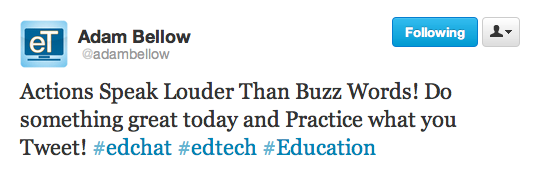
I hear a lot of talk about schools, principals, and teachers wanting to be innovative.  However, I contest, that we must be much more than innovative.  Just using the latest teaching strategies or the newest technology does guarantee success.  As Adam Bellow says, "Actions speak louder than buzz words."


Look at the difference between the definitions of innovation and implementation. Innovation is simply the new, where implementation is the act of accomplishing some aim.  It takes more than a cool tool to do something great, but you must accomplish something and have aim.  How do you get there?  How do you move from an amazing idea to amazing results? Here are things our presenters touched on with my thoughts.

1.  You Explore and Adopt/Reject

I think this first step speaks directly to the Adam Bellow tweet above.  There are some amazingly awesome ideas out there when it comes to education.  However, we cannot just randomly pick the "flavor of the month", tell our teachers to "do it", and hope for success.  We must look at the innovation, whether its a new teaching model, piece of technology, or an app, and explore it to make sure it's the right choice for our students and our school.  I am not the first person to say this and I won't be the last, but we have to make sure the things we are implementing will bring us closer to what we are trying to accomplish.  I have seen many great websites, apps, and pieces of technology in my job and have instantly thought about how cool it would be to use such a tool in my work.  However, when I got over the initial excitement and began to think about it's usefulness, I realized that I was fine without it and it didn't fit the needs of my class.  Set goals, and then find the innovation that will bring you closer.  Remember, implementation is about "aim".

2. Planning

If you think we run through step 1, then you better not blink or you'll miss the planning stage.  We have a tendency to fall in love quickly with the new and then just throw it out there and hope it sticks.  Success does not happen by accident, you have to aim for it.  When moving from innovation to implementation, the first thing you need to plan for is what and how you are going to assess the success of the innovation.  Just like a good teachers decides how they are going to assess what they are teaching BEFORE they teach it, those who are going to introduce something new to a staff must do the same thing. You must decide what it is you are looking for and how you are going to measure for that success.  Secondly, you must decide how you are going to support those who are implementing the new concept or tool.  Then, once you have decide what you looking for, how you are going to measure it, and how you are going to support it, you plan on how you are going to introduce it.  Finally, plan on what the innovation looks like when it is fully implemented.  A good teacher wouldn't give his or her students a project without showing them the rubric by which it was going to be graded and giving examples.  Design a rubric of innovation that spells out what you are expecting this innovation to look like fully implemented in the classroom.  Then stair-step down a few levels to show teachers where they can start and how to build up to full implementation.

I personally believe you must have these things in place before you introduce the innovation to the staff because it will help you get buy in.  If the staff see that you and your team have done your homework, picked an innovation that serves a purpose, set a goal, designed adequate tools to measure success, planned to support, and have spelled out what your expectations are along the way, then they are more likely to buy in.  Without buy in, I don't care how good the innovation is...it won't work.

3.  Implementing

With your plan in place, you can now move forward and implement the innovation.  This section becomes a lot shorter because you planned well before you got here.  When you get to this point, trust the plan and stick to it.  We deviate and allow things to slide during the implementation stage if we have not adequately planned.  Don't compromise any part of the plan if it's going to undermine the integrity of the innovation.  Now I'm not saying you can't make adjustments on the fly, because you certainly can and will.  However, there probably won't be any sweeping changes to the plan, if you have adequately planned.  Also, be open, honest, and realistic throughout the implementation stage of the innovation.  Know when to push ahead and know when to slow down.  Putting something new into place is a delicate process and timing is everything.  Implementing is not like downloading an update to an app.  I don't have to convince my iPad that the latest update to GarageBand is a good idea.  However, education is very personal and you can almost always expect to have push back at this stage in the game.  Push back is not a negative thing.  It's through resistance, that we gain strength.

4.  Continuously Improve

I don't care how well you explored, planned, or implemented, nothing is ever perfect the first time through.  This is why you planned to assess.  This is why you planned to support.  This is why you planned to implement.  So that while you are working through this process you are making adjustments as needed.  Of course, this is also the time where you can decide if the innovation was the wrong choice and go a different direction.

Throughout this blog post I have used the word "you".  However, do not think I believe the journey from innovation to implementation occurs just because of the work of one person.  Every step of this process must be a team effort.  Throughout the process of moving from innovation to implementation I encourage you to include all staff, students, parents, and the community.  Great things occur when we when we all work together for a cause greater than ourselves.

Professional development is all about gradual release.  When you move from innovation to implementation, that which is innovative becomes an imbedded tool in the teachers' tool-belt. Unfortunately, for too long it has been more like "catch and release".  We bring educators into a room, catch their attention with something shiny, and release them into the wild.  Gradual release is a longer process that takes patience and dedication, but in the end everyone benefits.

Flipping Professional Development

Last week I worked with almost 100 educators from my district in the area of flipping the classroom over a period of two days.  These two sessions were lead by well-known "flipper", Brian Bennett, another colleague of mine, Brian Bobbitt, and myself.  It was a fantastic two days and there was a lot of excitement.

Being a part of these sessions allowed me to really think about the way we do professional development.  I must admit, I enjoyed the second day a lot more than the first day. It's not that the first day was a bad day and not because I was called out an hour early because my wife went to the ER for what turned out to be a kidney stone (She's fine now by the way).  I think the second day went better than the first day because of a small adjustment we made to the schedule based on feedback and our own personal observation from the first day.

The first day we started off talking about the philosophy and rationale of the flipped classroom.  We spent about an hour presenting on the purpose of the flipped classroom, the misconceptions of the flipped classroom, and what we would be covering during the day.  It was the same type of presentation I had done several times at different conferences.  However, it was mainly Brian and me talking and then fielding questions.  I found myself thinking throughout that first hour that we were talking way too much and we were demonstrating the very reason why I am a proponent of the flipped classroom.  I even leaned over to Brian at one point and mentioned that it was very ironic that we were up here talking as much as we were.  It really slowed the morning down and I think brought down the energy.  Now, it was still a good day and we got great feedback from our participants but I left knowing it could be better.


We had a day off between sessions and we communicated through email about what we wanted to do differently.  Quickly the idea was given that we needed to shorten the first hour and give more time for our participants to collaborate.  Brian Bennett shared with us a shorter presentation that he had given at another conference.  I asked him if he could make a video of that presentation that I could email out to our participants to view before they came the next day.  This is what he made in a matter of 30 minutes:


The next day when we began we did a quick formative assessment to see who had watched the video, had discussion about the content, and we were off and running.  It helped us add another hour of collaboration time because we flipped a portion of the day.  It also helped us demonstrate the power of flipping a classroom.  I heard several comments of appreciation because of the time we gave our participants to collaborate.


One of my favorite conversations I had the second day was with a group of instructional coaches and administrators from my district and how they can flip professional development.  One of the biggest complaints I had as a teacher and one of the biggest complaints I hear working in professional development is that we don't have enough time to work.

I personally experienced traditional PD this past Friday in a session for a leadership cadre that I belong to in my district.  I sat in a session with around 70 leaders from my district and listened to two webinars on the common core.  Both webinars lasted close to an hour and I was bombarded with information.  There were several times when those who presented the sessions stopped and waited for questions.  Eventually there were some questions but not as many as you'd think. I am sure I would have had questions if my brain wasn't about to explode from my week at work and all the information they had just given me.  I kept thinking to myself, just like I did on the first session on the flipped classroom that I had lead earlier in the week, there has to be a better way.

What if those of us who work in the area of professional development begin to flip our PD sessions?  What if, instead of listening to those sessions live, I could have had access to those sessions ahead of time, listened to them (at least once), digest the information, and then brought questions with me to the meeting?  Then the two people who presented the sessions could have still video conferenced in with us, and we could have have had a better conversation.  I just kept thinking to myself, "Here we are, some of the best educators in my district in the same room, and we're looking at computer screens."  The next day we applied what we had learned in some very meaningful activities.

Here is how I could see professional development done "flipped classroom" style:

  1. The presenter making a video presentation of the material they would be presenting at the PD session.
  2. Participants would watch the video ahead of time.
  3. Participants would come the PD session with questions or maybe a completed task.
  4. Then the participants would be engaged in a collaborative session with an expert, instead of the "sit and get" session most of us teachers are all too familiar with.
Now I know there would those that wouldn't watch the videos, just like there are in a flipped classroom.  However, I think that we would find most teachers would come to the sessions prepared.  All I know for sure is that when Brian, Brian, and I flipped our PD session on the flipped classroom, all I heard over and over again were participants who appreciated the time to collaborate with each other and to have experts near by when they had questions.  


Flipped Classroom PD - Let the adventure begin!

Flipped Classroom PD - Let the adventure begin!

On January 17 and 19, two of my colleagues and myself will be starting an action research project on the flipped classroom.  My colleagues are none other than Brian Bennett (@bennettscience) and Brian Bobbitt (@MrBrianBobbitt).  If you have read my blog at all, you know how I feel about the flipped classroom and I'm not going to revisit why I'm passionate for this ideology in this post.  However, if you have any questions, please leave them in the comments and I'll respond.

Towards the end of last semester Brian Bobbitt created a weebly website and sent it out to the staff in our corporation to find out the level of interest in the flipped classroom model.  We had a tremendous response and that is why we were given the days for professional development.

As of right now, we have 63 teachers, coaches, or administrators signed up for the professional development days and 17 spots left to fill.  It is going to be a great time and I can not wait for Brian, Brian, and I to share our knowledge and to learn from our participants.  However, I'm more excited about the potential impact this could have on our students and our district.

I hope that from these PD days that we will spark teachers interest and encourage them to find a way to make their students the center of their classroom.  We will be following up with teachers and collecting data throughout the second semester, the summer, and next school year.  The Brians and I will be providing support throughout this entire project and, I'm sure, learning a lot ourselves along the way.

Flipping the classroom is not the answer to solving all of the flaws in our education system.  However, neither is doing nothing and continuing on like nothing is wrong.  I look forward to blogging more about this over the next 2 years.

Now I look to you, if you were attending a one day PD session on the flipped classroom, what would you want to learn?  Please leave your answers below in the comments.

Don't Teach Twitter...

The title of this blog may come as a shock to those of you who know me, but I promise you I have not gone crazy.

My colleagues and I had a very interesting discussion today in our weekly eLearning team meeting.  The discussion was centered around Twitter and if we should open it up for students.  Just for some background information, I work in a 1:1 environment, there are certain websites that are blocked no matter where the students are at with their Netbooks, and websites like Twitter, Facebook, and YouTube are only open on staff computers and in computer labs.

It was a good discussion about the pros, cons, how many teachers would actually use it (Is there a magic #?), and what type of education/PD would we, as eLearning Coaches, need to provide.  Anyway, it really got me thinking about what do we really need to teach students.

First of all, I am all for opening up twitter to all students.  It is a fantastic tool that I use on a daily basis.  When I have a question, I am just as likely to tweet the question to my PLN as I am to look it up on Google.  I can think of all kinds of ways to use it in the classroom, for professional learning, and for personal enjoyment.

Beyond that, part of me dies every time we hinder learning.  Make no mistake about it, when we block websites unnecessarily, and restrict our students access to information, we are hindering learning.  I am not sure what we are afraid they will learn out there in "the wild".  I grow weary of students being told what to learn, when to learn, how to learn, and how to show teachers that they have learned.  

That being said, as I pondered opening it up for students and the question of how do we accomplish that, I am not sure if I think we should teach Twitter to our students.  Here is why, Twitter is just a tool. While I think that Twitter will be around for a long time, I am also certain there will be a day when Twitter will be dethroned.  The real question is, what is your expected outcome?  Do we want our students to learn the latest tool that, in the end, will only be around for a fraction of their lives?  Or do we want to teach them how to interact in society?  A skill that will stay with them their entire lives.

What if we just taught communication and collaboration skills?  Then students and teachers can just use the tool that best fits their needs.  Here is my recommendation and I'd love to hear your thoughts/comments about this on Twitter, Facebook, email, the comment section, or hit me up on my pager.  Lets make sure everyone knows the proper way to communicate and collaborate.  It doesn't matter if it's in person, online, Twitter, Facebook, Skype, Google+, email, smoke signals, or some way that hasn't been imagined yet.  Communication is communication, no matter the forum.  Then, grant our students access and expose them to the tools that are available and support their use of those tools.